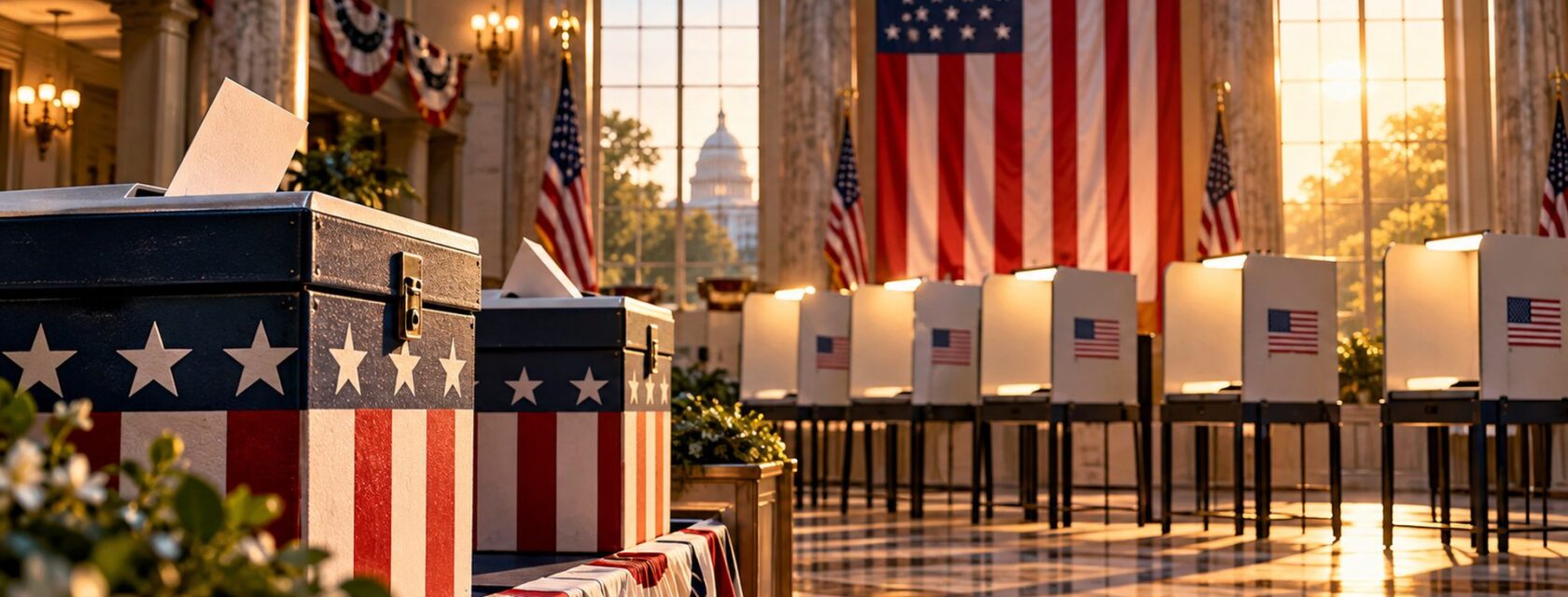
- How U.S. Midterm Elections Work and the Timeline Leading Up to the General Election on November 3, 2026
- Seats as of October 14, 2026, and key issues (cost of living and tariffs, healthcare, immigration, military conflict with Iran, and redistricting)
- The positions of both parties, the issues voters consider most important, and developments in the countries involved
- Four Factors That Will Determine the Outcome, Three Scenarios (Assumptions, Conclusions, and Future Prospects), and Options for the New Legislature
The Significance of the Two Elections
This article is based on information available as of October 14, 2026. It draws primarily on official sources, though some private-sector sources are also used.
In the United States, Congress elections held in the year between presidential elections are called “midterm elections,” and the next one will take place in November 2026. (Source: “Federal Elections and Midterm Elections,” the U.S. government’s comprehensive information website)
The midterm elections will determine which party holds the majority in the Senate and the House of Representatives for the next two years.
How Elections Work
Congress Elections
Members of the House of Representatives serve two-year terms, and all 435 seats are up for election every midterm election year and every presidential election year. The Senate has 100 members, with two senators elected from each state. Although their terms are six years, they are staggered so that not all members are up for election at the same time; one-third of the members are elected every two years. As a result, there are years when there are no Senate elections in a given state. (Source: U.S. Government General Information Website, “Congressional Elections and Midterm Elections”)
The U.S. Constitution stipulates that to be eligible for election to the House of Representatives, a person must be at least 25 years of age, have been a U.S. citizen for at least seven years, and be a resident of the state from which they are elected. To be eligible for election to the Senate, a person must be at least 30 years of age, have been a U.S. citizen for at least nine years, and be a resident of the state from which they are elected. (Source: National Archives and Records Administration, “U.S. Constitution”)
The U.S. Constitution provides that, as a general rule, the state legislatures shall determine the time, place, and manner of elections for members of the Senate and the House of Representatives. At the same time, it provides that Congress may, by law, establish or alter these rules, except for those governing the place where members of the Senate are elected. (Source: National Archives and Records Administration, “U.S. Constitution”)
Presidential Election
The presidential election begins with the process of selecting candidates from political parties. Many states hold primaries 6 to 9 months before the general election. In the primaries, voters cast secret ballots, and delegates are allocated to candidates based on the results. Some states hold caucuses, which are meetings organized by political parties. The selected delegates attend their party’s national convention, where the major political parties nominate their presidential and vice presidential candidates. (Source: U.S. Government General Information Website, “Presidential Election Primaries and Party Conventions” and “Presidential General Election”)
This election is held every four years on the Tuesday following the first Monday in November. When voters cast their ballots for a presidential candidate, they are actually voting for electors who support that candidate. The Electoral College is not the name of a place, but rather the name of a process. It consists of three parts: the selection of electors, the casting of votes by the electors, and the tabulation of votes by Congress. (Source: National Archives and Records Administration, “What Is the Electoral College?”)
There are a total of 538 electors. To be elected, a candidate must receive a majority of votes—at least 270. The number of electors for each state is equal to the number of that state’s representatives in the House of Representatives, plus two senators. Under the 23rd Amendment, Washington, D.C., is allocated three electors. (Source: National Archives and Records Administration, “What Is the Electoral College?”)
In 48 states and Washington, D.C., the candidate who wins the most votes in a state receives all of that state’s electoral votes. Maine and Nebraska use a different method of allocation. Under this system, a candidate who receives fewer votes nationwide can still win the presidency by securing more electoral votes. This happened in 2016 and 2000, as well as on three occasions in the 1800s. (Source: “Electoral College,” the U.S. government’s comprehensive information website)
To be eligible for the presidency, a person must be a U.S. citizen by birth, at least 35 years of age, and have resided in the United States for at least 14 years. The term of office is four years. The 22nd Amendment limits a person to serving no more than two terms as president. (Source: National Archives and Records Administration, “The Constitution of the United States,” “Amendments to the Constitution of the United States”)
Schedule for the 2026 Midterm Elections
The following is a summary based on the list of primaries as of May 18, 2026, published by the Federal Election Commission. (Source: Federal Election Commission, “Schedule of Primaries for the 2026 Congress Elections”)
| Time | Contents |
|---|---|
| March 3 | The earliest state primaries (Arkansas, North Carolina, Texas) |
| March–September | States hold their primaries in sequence. Some states hold a runoff election if necessary. |
| September 15 | The latest state primary (Delaware; excluding the member of the House of Representatives from Louisiana) |
| November 3 | General Election |
| December 12 | Runoff election for the U.S. House of Representatives seat from Louisiana |
The schedule in Louisiana differs from that of other states. The primary election to select a member of the Senate was held on May 16, and the runoff election was held on June 27. The primary election to select Louisiana’s representatives to the House of Representatives was postponed to November 3 following a ruling by the Supreme Court. The list includes a note stating that dates are subject to change.
Current Situation: Seats and What Is Currently Being Debated
Current Composition of the Administration and Congress
The current president is Donald Trump of the Republican Party. (Source: Encyclopædia Britannica) The composition of the House of Representatives is as follows. (Source: House Press Gallery, “Seats by Party”)
| Caucus | Number of seats |
|---|---|
| Republican Party | 218 |
| Democratic Party | 214 |
| Independent | 1 |
| Vacancy | 2 |
In this election, all 435 seats in the House of Representatives and 35 seats in the Senate are up for election. Since we were unable to obtain the current number of Senate seats from official sources, the figures below are based on private sources.
According to the Britannica Encyclopedia, a private encyclopedia, prior to the election, the Senate consisted of 53 seats from the Republican Party and 45 seats from the Democratic Party, with two independents aligning with the Democratic Party. For the Democratic Party to secure a majority in the Senate, it must retain its current seats and win four seats from the Republican Party. (Source: Encyclopædia Britannica, “2026 U.S. Midterm Elections”)
According to an October 13, 2026, article by the Council on Foreign Relations, a private research organization, the Democratic Party needs a net gain of three seats to secure a majority in the House of Representatives. Of the 35 Senate seats up for election this time, 22 are currently held by the Republican Party, and 20 of those are in states where Mr. Trump won by a margin of 10 points or more in 2024. Among the seats the Democratic Party is defending are Georgia and Michigan—both states where Trump won—and in four states, incumbent Democrats are retiring. (Source: Council on Foreign Relations, “5 Things You Need to Know About the Midterm Elections”)
What Both Parties Are Advocating
At a press conference in September, Republican Party House of Representatives Speaker Mike Johnson cited border control, tax cuts for working families, and lower prescription drug prices as achievements, noting that inflation has fallen and employment has risen, and stated that he would continue on this path next year. He also argued that if the Democratic Party gains a majority in the House of Representatives, they would reverse the tax cuts and reopen the border. (Source: Statement by House of Representatives Speaker Johnson)
In remarks made in September, Democratic Party House of Representatives Minority Leader Hakeem Jeffries stated that the cost of living is too high and claimed that tariffs have increased the burden on people by thousands of dollars a year. He criticized the Republican Party for implementing the largest Medicaid cuts in U.S. history and called the war in Iran reckless, vowing to end it. (Source: Jeffries’ statement)
Issue 1: Living Expenses and Tariffs
On February 20, 2026, the Supreme Court ruled that the International Emergency Economic Powers Act does not grant the President the authority to impose tariffs. The President subsequently proclaimed tariffs based on Section 122 of the Trade Act of 1974. Section 122 authorizes temporary import surcharges of up to 15% for a maximum of 150 days. (Source: Congressional Research Service, “Supreme Court Rejects Tariffs Under the International Emergency Economic Powers Act”) In his proclamation, the President explained that these tariffs are intended to address a large and serious balance of payments deficit. (Source: Presidential Proclamation) The Congressional Research Service states that it is unclear whether Section 122 can be used to address trade deficits. (Source: Congressional Research Service, “Supreme Court Rejects Tariffs Under the International Emergency Economic Powers Act”)
The deadline for the Section 122 tariffs was July 24. In July, the Office of the United States Trade Representative decided, pursuant to Section 301 of the Trade Act, to impose tariffs of 10% or 12.5% on imports from 60 countries and regions. The Office of the United States Trade Representative has explained that these measures are intended to eliminate products made with forced labor from global supply chains. (Source: Briefing materials from the Office of the United States Trade Representative; statement from the Government of Canada)
Issue 2: Healthcare, Immigration, and Borders
On the issue of healthcare, House of Representatives Speaker Johnson has stated that he is pursuing a path to lower healthcare costs by increasing competition and choice. On immigration and border security, House of Representatives Speaker Johnson lists border control as his top priority. Mr. Jeffries’ website calls the administration’s immigration policy “cruel” in reference to the termination of Temporary Protected Status for Haitians and Syrians. (Source: Statement by Speaker of the House of Representatives Johnson; statement and website by Mr. Jeffries)
Issue 3: Military Conflict with Iran and Crude Oil Prices
On February 28, 2026, the United States and Israel attacked Iran, and the conflict spread to the surrounding region. The president stated that the purpose of the attack was to eliminate an imminent threat posed by the Iranian regime. By March, shipping traffic through the Strait of Hormuz had come to a virtual standstill. (Source: Congressional Research Service, “U.S.-Iran Conflict”)
According to the U.S. Energy Information Administration, the price of crude oil (Brent) futures fell to $72 per barrel on July 1. However, attacks resumed on July 7, and the price rose to $109 on September 15. The U.S. Energy Information Administration explains that the market at the end of September was torn between peace talks and the possibility of the war spreading. (Source: U.S. Energy Information Administration, “Crude Oil Prices in the Third Quarter”)
According to a March 26 report by the Congressional Research Service, the administration had not formally requested additional funding. This article does not address developments since then. (Source: Congressional Research Service, “U.S.-Iran Conflict”)
Redistricting
According to the Britannica Encyclopedia, a private encyclopedia, House of Representatives districts are typically redrawn following the decennial census. However, in 2025, the president called for the redrawing of Texas’s congressional districts so that the Republican Party could gain five additional seats. In a November 2025 referendum, California approved a redistricting plan that created five seats favorable to the Democratic Party, with 64% of voters in favor. In Virginia, the state Supreme Court ruled that a redistricting plan favorable to the Democratic Party was unconstitutional. Encyclopædia Britannica lists a total of 10 states that have redrawn their districts or attempted to do so. This article does not determine which party, overall, stands to benefit from these changes. (Source: Encyclopædia Britannica, “2026 U.S. Midterm Elections”)
On April 29, 2026, in a case concerning Louisiana’s congressional districts, the Supreme Court ruled that the Voting Rights Act does not require Louisiana to create additional districts with a majority of minority residents, and that Louisiana’s new redistricting plan—which was drawn along racial lines—was unconstitutional. (Source: Supreme Court decision “Louisiana v. Callais”) According to the Encyclopædia Britannica, several Southern states also redrew their district boundaries following the ruling. (Source: Encyclopædia Britannica)
Issues that voters consider important
In a survey conducted by the Pew Research Center, a private research organization, from September 28 to October 4, 84% of registered voters said the economy was “very important” to their voting decision. Concerns about prices are growing, particularly regarding gasoline and energy. Healthcare was cited by 82% of supporters of candidates from the Democratic Party and 53% of supporters of candidates from the Republican Party. Immigration was cited by 72% of supporters of candidates from the Republican Party and 53% of supporters of candidates from the Democratic Party.
In the House of Representatives election, 44% support candidates from the Democratic Party and 36% support candidates from the Republican Party, a difference of 8 percentage points. Fifteen percent have not yet decided. Sixty-three percent say they base their voting decision on the president; of those, 44% view their vote as a vote against the president, while 19% view it as a vote in support of him. Among adults overall, the president’s approval rating stands at 30%. One-third of respondents support the president’s handling of the conflict with Iran, while 77% believe the conflict will continue for at least another six months.
On the other hand, 67% of those who voted for Mr. Trump in 2024 still support him as president. Among those who voted for Mr. Trump, 77% said they would vote for a candidate from the Republican Party in the upcoming election for the House of Representatives, while 13% remain undecided. Twenty-five percent of those who voted for Trump do not view the Republican Party favorably; among this group, 49% said they would vote for a Republican candidate, 12% for the Democratic Party, and 25% were undecided. Among those who said they were highly motivated to vote, candidates of the Democratic Party had a 17-point lead in support. These figures are as of the time of the survey. (Source: Pew Research Center survey)
Developments in the Countries Involved
The Canadian government characterized the Section 301 tariffs as part of the United States’ unilateral trade measures and stated that it would continue constructive consultations with the United States. (Source: Canadian government statement) The European Union has implemented a system setting tariffs on a wide range of U.S.-origin products at 0% effective July 1, 2026. The European Commission has stated that it may suspend this preferential treatment if, for example, the United States fails to honor its commitments under the joint statement. (Source: European Commission trade information website)
Future Developments and Scenario Analysis
Upcoming Milestones
The dates listed below for the presidential election were calculated by this article based on the same rules applied previously and have not been officially announced. (Sources: National Archives and Records Administration, “What Is the Electoral College?” and “Amendments to the United States Constitution”; Federal Election Commission, “Schedule of Primaries for the 2026 Federal Congress Elections”)
| Milestone | Rule | Last time | Next Time |
|---|---|---|---|
| The General Election for the Midterm Elections | List Published by the Federal Election Commission | - | November 3, 2026 |
| Start of the Term for New Members of the Congress | Noon on January 3 | - | January 3, 2027 |
| The General Election for President | The Tuesday following the first Monday in November | November 5, 2024 | November 7, 2028 |
| The President's Inauguration | January 20 of the following year | January 20, 2025 | January 20, 2029 |
Factors Influenced by the Composition of the Legislature
The U.S. Constitution grants the following powers to the Senate and the House of Representatives. (Source: National Archives and Records Administration, “U.S. Constitution”)
- A bill becomes law after it passes both the Senate and the House of Representatives and is sent to the president. If the president vetoes a bill, it becomes law if both chambers pass it again by a two-thirds majority.
- Senate confirmation is required for the conclusion of treaties and the appointment of ambassadors and Justices of the Supreme Court.
- Congress has the authority to levy taxes, including customs duties; to regulate commerce with foreign nations; and to declare war.
Four Factors That Make the Difference
What follows is not a statement of fact, but rather an analysis based on the facts presented so far. This article does not offer any predictions regarding the outcome. The outcome depends on the assumptions made regarding the following four points.
- Crude Oil and Iran: The question is how crude oil prices and the situation in Iran will unfold before Election Day. According to the survey above, the economy is the most important issue for supporters of both parties.
- Voting criteria: Whether voters base their choice on their assessment of the administration (cost of living, tariffs, the war in Iran) or on specific policies such as their preferred political party, border control, or tax cuts.
- Voters: The key question is how the behavior of those who voted for Mr. Trump and the high level of enthusiasm among supporters of candidates from the Democratic Party will play out at the polls.
- Redistricting: The question is which party, overall, will benefit from the changes to the electoral districts.
For the Senate majority to shift, the Democratic Party would need to gain a net total of four seats in addition to this. The following three scenarios are based on different assumptions regarding these four points. We have not considered the scenario in which the Republican Party retains the House of Representatives and the Democratic Party wins the Senate, as it is believed that if there is enough headwind to shift the Senate, the House of Representatives would also shift.
Scenario 1: The Republican Party retains majorities in both chambers
Assumption
Regarding crude oil and Iran, we assume that peace talks will progress, prices will fall, and dissatisfaction with the cost of living will ease. Currently, 77% believe the conflict will drag on. Regarding voting criteria, we assume that many of the 15% who are undecided will base their choice on issues such as immigration, border control, and tax cuts rather than their assessment of the administration. Among those who plan to vote, we assume that the core group—those who voted for Mr. Trump but are currently undecided—will return to the candidate of the Republican Party, narrowing the gap in voter enthusiasm. Based on current figures, closing the 8-point gap would require more than three-quarters of undecided voters to shift their support to the Republican Party candidate (according to this article’s calculations). We assume that redistricting will favor the Republican Party overall, as the gains in Texas and other Southern states will outweigh those in California.
Conclusion
If all four of these conditions are met and the gap is closed, the Republican Party will retain its majority in the House of Representatives. In the Senate, since most of the seats the Republican Party is defending are in states where Mr. Trump is strong, the Republican Party is likely to hold onto its seats and may even win seats in Georgia and Michigan, which are currently held by the Democratic Party. This outcome will be seen as an endorsement of the administration’s policies. Motivation within the Republican Party to challenge the administration will wane; tariffs imposed under Section 301 will continue; and if the administration seeks additional funding for the war effort, it will be easier to secure congressional approval. Negotiations with Canada and the European Union are expected to proceed on the assumption that the current tariffs will remain in place.
If the assumption is proven wrong
The more this assumption is disproven, the more likely it is that the House of Representatives will swing to the Democratic Party, bringing us closer to Scenario 2. According to an article by the private think tank Council on Foreign Relations, the president’s party has lost seats in the House of Representatives in 37 of the past 41 midterm elections.
The Outlook Ahead
Looking ahead to the 2028 presidential election, it is believed that a candidate from the Republican Party who continues the current policy direction will have an advantage. The practice of redrawing electoral districts midway through a term could spread to other states.
Scenario 2: The Democratic Party holds a majority in the House of Representatives, while the Republican Party holds a majority in the Senate
Assumption
Regarding crude oil and Iran, we assume that prices will remain high and tensions will continue. In terms of voting behavior, we assume that in the elections for the House of Representatives, many voters will cast their ballots based on their assessment of the administration, and that the current 8-point gap will largely hold. Among those who turn out to vote, we assume that the trends observed in the House of Representatives polls will hold true for the Senate elections as well; in states where Mr. Trump won by a margin of 10 points or more, we assume that many of those who voted for Mr. Trump will also vote for the Republican Party Senate candidate. We assume that redistricting will have a negligible overall effect.
Conclusion
Since all seats in the House of Representatives are up for election, national trends are likely to be reflected in the seat count, increasing the likelihood that the Democratic Party will gain a net total of three seats. In the Senate, however, because many of the contested seats are in states where Mr. Trump remains strong, it will be difficult for the majority to shift, even if there is widespread dissatisfaction. An article by the private Council on Foreign Relations points out that in the 2022 midterm elections, the Democratic Party lost nine seats in the House of Representatives but gained one seat in the Senate. With this outcome, bipartisan agreement is required to pass legislation. The Democratic Party is expected to demand a reduction in the tariff burden and a review of Medicaid as conditions for supporting the budget. The Republican Party will seek to protect tax cuts and border policies by leveraging its Senate majority and the president’s veto power. The administration will have to rely more on measures such as Section 301 tariffs, which can be imposed under the authority of the Office of the United States Trade Representative. From the perspective of other countries, commitments that require congressional approval become harder to predict.
If the assumption is proven wrong
If the 8-point gap narrows by Election Day, we will move closer to Scenario 1. If dissatisfaction spreads even to states where Mr. Trump is strong, and voters who supported Mr. Trump turn away from the candidate of the Republican Party, we will see Scenario 3.
The Outlook Ahead
Over the two-year period beginning in 2027, the two parties are likely to clash over every budget, and it is possible that some government agencies could shut down. In the 2028 presidential election, the performance of the government during those two years is expected to be a key issue.
Scenario 3: The Democratic Party Wins Majorities in Both Chambers
Assumption
Regarding crude oil and Iran, we assume that prices will remain high or rise even further. In terms of voting criteria, we assume that the public’s assessment of the administration will be a deciding factor even in states where Mr. Trump is strong. Among those who do vote, we assume that many of Mr. Trump’s supporters who do not favor the Republican Party will either stay home or vote for a candidate other than the Republican nominee. Current polls show that 49% of these voters are currently supporting the Republican candidate, so a significant shift is needed here. We assume that the effects of redistricting will be outweighed by the national margin. Furthermore, we assume that of the approximately six seats held by the Republican Party that are currently in a tight race, the Democratic Party will win at least four while holding onto its own seats. This is a separate assumption that cannot be derived from the four points mentioned above.
Conclusion
An article by the private Council on Foreign Relations states that, due to a combination of the president’s low approval ratings, rising fuel prices, and the growing cost of living, approximately six seats—which were previously considered safe for the Republican Party—are now up for grabs. If this scenario plays out, the Democratic Party would secure a majority in the Senate as well, and the administration’s agenda would be seen as having been defeated. Congress would then be able to aim to pass bills to limit tariff authority, reform Medicaid, and adopt a resolution restricting the use of force in Iran. However, since a two-thirds majority in both chambers is required to override a presidential veto, there will be limited instances where congressional policy becomes law as is. Consequently, the focus of the conflict will shift to personnel appointments—which require Senate confirmation—and the budget. The administration is expected to rely even more heavily on measures that can be implemented solely through the president’s authority. The nations involved in negotiations are likely to assess how to proceed with discussions while observing the differences in policy between Congress and the administration.
If the assumption is proven wrong
If the Democratic Party fails to gain a net total of four Senate seats, Scenario 2 will come into play. If other assumptions—such as a drop in crude oil prices—fail to materialize, the Republican Party is likely to retain its Senate majority.
The Outlook Ahead
The 2028 presidential election will be a referendum on how voters assess the past two years of conflict between Congress and the president. The Democratic Party, despite holding a majority, has often been unable to fulfill its campaign promises, creating a disconnect with its supporters’ expectations. The Republican Party will face the question of whether to continue on its current course or change direction.
Comparison of the Three Scenarios
| Points of Comparison | Scenario 1 | Scenario 2 | Scenario 3 |
|---|---|---|---|
| Crude Oil and Iran | Crude oil prices are falling | Crude oil prices remain high | Crude oil prices aren't falling |
| Voting Criteria | Voters make their choices based on specific policies and the political parties they support. | In House of Representatives elections, voters cast their ballots based on their assessment of the administration. | In every state, voters cast their ballots based on their assessment of the administration. |
| People who go to vote | People who voted for Trump are returning to the candidate of the Republican Party | In states where Trump is strong, people who voted for Trump will vote for a candidate from the Republican Party. | Some of those who voted for Mr. Trump will not vote for the candidate of the Republican Party |
| Redistricting | Redistricting Works in the Favor of the Republican Party | Overall, the impact of the electoral district changes is minor. | The difference in support across the country is greater than the effect of the redistricting. |
| Tariffs | Tariffs Will Continue | Tariffs Will Continue, but the Democratic Party Is Seeking Conditions in the Budget | Congress passes a bill limiting the president's tariff authority, and the president vetoes it |
| War expenses in Iran | Additional spending is more likely to pass the legislature | Additional spending is subject to conditions | The legislature aims to pass a resolution restricting the use of force |
| Negotiating Partner Country | The other country is negotiating on the basis of the current tariffs. | It is difficult to predict the outcome of commitments that require legislative approval. | The other country will make its decision based on the differences between the legislature and the administration's policies. |
Presenting Options
After the midterm elections, the new Congress will have to decide how to respond to the administration’s current policies (tariffs, border control, tax cuts, and the approach toward Iran). The following is an analysis, not a statement of fact. It does not indicate which course of action is preferable.
In addition, although this article does not address it, establishing nationwide standards for electoral district boundaries is another option.
Reference Information
- USAGov: Congressional elections and midterm elections
https://www.usa.gov/midterm-elections - USAGov: Electoral College
https://www.usa.gov/electoral-college - USAGov: Presidential general election
https://www.usa.gov/presidential-general-election - USAGov: Presidential primaries and caucuses
https://www.usa.gov/primaries-caucuses - National Archives: What is the Electoral College?
https://www.archives.gov/electoral-college/about - National Archives: The Constitution of the United States: A Transcription
https://www.archives.gov/founding-docs/constitution-transcript - National Archives: The Constitution: Amendments 11-27
https://www.archives.gov/founding-docs/amendments-11-27 - House Press Gallery: Party Breakdown
https://pressgallery.house.gov/member-data/party-breakdown - Federal Election Commission: 2026 Congressional Primary Dates and Candidate Filing Deadlines for Ballot Access
https://www.fec.gov/resources/cms-content/documents/2026pdates.pdf - Congressional Research Service: Supreme Court Rules Against Tariffs Imposed Under the International Emergency Economic Powers Act (IEEPA)
https://www.congress.gov/crs_external_products/LSB/PDF/LSB11398/LSB11398.1.pdf - Office of the United States Trade Representative: Fact Sheet: USTR Section 301 Action in Response to the Failure of 60 Economies to Ban Imports Produced with Forced Labor
https://ustr.gov/about/policy-offices/press-office/fact-sheets/2026/july/fact-sheet-ustr-section-301-action-response-failure-60-economies-ban-imports-produced-forced-labor - Supreme Court of the United States: Louisiana v. Callais
https://www.supremecourt.gov/opinions/25pdf/24-109_21o3.pdf - Congressional Research Service: U.S. Conflict with Iran
https://www.congress.gov/crs_external_products/R/PDF/R48887/R48887.1.pdf - Congressional Research Service: U.S.-Iran Ceasefire: Assessment, Reactions, and Issues for Congress
https://www.congress.gov/crs_external_products/IN/PDF/IN12678/IN12678.1.pdf - U.S. Energy Information Administration: Crude oil prices and refinery margins generally increased throughout the third quarter
https://www.eia.gov/todayinenergy/detail.php?id=68245 - Speaker of the House Mike Johnson: Republicans Have Delivered a Secure Border, Safe Streets, More Affordable Prescription Drugs, and Common Sense
https://www.speaker.gov/2026/09/15/speaker-johnson-republicans-have-delivered-a-secure-border-safe-streets-more-affordable-prescription-drugs-and-common-sense/ - Congressman Hakeem Jeffries: Leader Jeffries on Squawk Box
https://jeffries.house.gov/2026/09/28/leader-jeffries-on-squawk-box-people-are-drowning-in-this-failed-republican-economy/ - Congressman Hakeem Jeffries: Leader Jeffries in Providence
https://jeffries.house.gov/2026/09/21/leader-jeffries-in-providence-affordable-healthcare-has-to-be-a-right-available-to-every-single-american/ - Global Affairs Canada: Statement by Minister LeBlanc on the imposition by the U.S. of Section 301 Tariffs related to forced labour practices
https://www.canada.ca/en/global-affairs/news/2026/07/statement-by-minister-leblanc-on-the-imposition-by-the-us-of-section-301-tariffs-related-to-forced-labour-practices.html - European Commission, Access2Markets: New EU tariff duties on imports of goods from the United States applicable from 1 July 2026
https://trade.ec.europa.eu/access-to-markets/en/news/new-eu-tariff-duties-imports-goods-united-states-applicable-1-july-2026 - Council on Foreign Relations: Five Things to Know About the Midterms
https://cfr.org/articles/five-things-to-know-about-the-midterms - Encyclopaedia Britannica: 2026 U.S. midterm elections
https://www.britannica.com/event/2026-US-midterm-elections - The White House: Imposing a Temporary Import Surcharge to Address Fundamental International Payments Problems
https://www.whitehouse.gov/presidential-actions/2026/02/imposing-a-temporary-import-surcharge-to-address-fundamental-international-payments-problems/ - Pew Research Center: Economy Ranks as Top Issue in Midterms for All Voters – But Partisans Differ Over the Importance of Other Issues
https://www.pewresearch.org/politics/2026/10/08/economy-ranks-as-top-issue-in-midterms-for-all-voters-but-partisans-differ-over-the-importance-of-other-issues/ - Pew Research Center: With Americans in a Sour Mood, Democratic Voters Are More Engaged in Midterms
https://www.pewresearch.org/politics/2026/10/08/with-americans-in-a-sour-mood-democratic-voters-are-more-engaged-in-midterms/
This article was written by AI from public records and non-governmental sources, and translated automatically.